The Broads National Park © The Broads Authority
Sustainable Tourism in European Protected Areas provides a meaningful quality experience, safeguards natural and cultural values, supports local livelihoods and quality of life and is economically viable.
Sustainable tourism is Good for Parks, Good for People!
Tourism is a booming business. It produces almost 5% of the world’s economic turnover, employs around 200 million people globally and is the fastest growing industry. Tourism is also one of the main economic drivers of Europe’s rural economies; directly and indirectly, it accounts for around 10% of European GDP and 20 million jobs.
Our iconic landscapes are often one of the most cited reasons for tourist visits to Europe.
Between 2000 and 2010 European countries recorded over 440 million annual international visitor arrivals. On top of this, an even greater amount of tourism activity can be added in the form of own-country (domestic) tourists and people on day trips (Practical, profitable, protected. A starter guide to developing sustainable tourism in protected areas. ECEAT International, the European Centre for Eco and Agro Tourism in partnership with the EUROPARC Federation 2012).
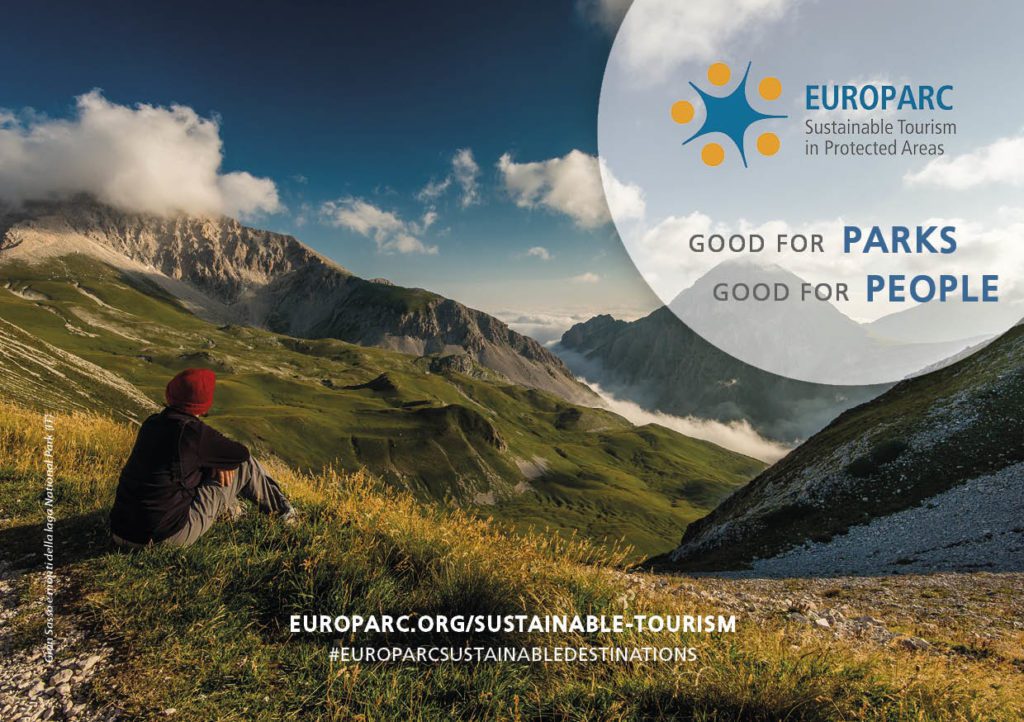
Download the brochure “Good for Parks, Good for People” in English, Spanish, Italian, French or Catalan
EUROPARC has long recognised the need to take care of both the land and the people who live and work there and often derive their livelihoods from those who come to appreciate these special places. We understand that not only are parks themselves facing challenges and pressure from visitation and misuse on the land they manage but have the opportunity and potential to act as catalysts for sustainability and lifestyle changes at a local and regional and indeed national level.
In 1993 EUROPARC published the groundbreaking report “Loving them to death”, which called for sustainable tourism in Europe’s Protected Areas. Further, in 1995, EUROPARC took the initiative to set up the European Charter for Sustainable Tourism in Protected Areas.
We believe that Sustainable Tourism is a state of mind, a conscious choice to work, live and be on holiday in a different way.
Watch our Award Winning Film “A Sustainable Destination“
The film was recognised at the Terres Travel Festival – Films & Creativity as the best movie promoting sustainability and was selected among more than a hundred audiovisual productions from 24 different countries.
“A Sustainable Journey” guides us through an experience of tourism that speaks to our hearts and minds. We can enjoy our holiday while being responsible and caring towards nature and the culture of the chosen destination. Watch this film in German, Italian, French or Spanish.
What is the European Charter for Sustainable Tourism (ECST)?
The European Charter for Sustainable Tourism (ECST) in Protected Areas is a practical management tool that enables Protected Areas to develop tourism sustainably.
The ECST is a process divided into 3 parts:
The first and main part is for sustainable destinations – primarily around a Protected Area. This is awarded to the protected area authority and covers a specifically defined ECST Area which may be wider than the legally designated protected area.
For sustainable local tourism businesses within the Sustainable Destinations.
For sustainable tour operators bringing visitors to Protected Areas.
Richard Denman, Director of The Tourism Company and member of the Evaluation Committee of the European Charter for Sustainable Tourism in Protected Areas speaks about the benefits that sustainable tourism brings to the populations living around Protected Areas and their level of awareness.
Mission of the ECST
The core element of the ECST is working in partnership with all relevant stakeholders to develop a common sustainable tourism strategy and an action plan on the basis of a thorough situation analysis. The aim of all ECST projects and activities is the protection of the natural and cultural heritage and the continuous improvement of tourism in the Protected Area in terms of the environment, local population and businesses as well as visitors.
Now, after over 20 years of experience, the ECST has proved to be a useful and important tool that delivers social, environmental and economic benefits and indeed can be described as a model of governance that delivers Protected Areas as sustainable tourism destinations. You can find the list of Sustainable Destinations here.
Principles of the ECST
The following principles should govern how tourism is developed and managed in Protected Areas:
1. Giving priority to protection
A fundamental priority for the development and management of sustainable tourism should be to protect the area’s natural and cultural heritage and to enhance awareness, understanding and appreciation of it.
2. Contributing to sustainable development
Sustainable Tourism should follow the principles of sustainable development which means addressing all aspects of its environmental, social and economic impact in the short and long term.
3. Engaging all stakeholders
All those affected by sustainable tourism should be able to participate in decisions about its development and management, and partnership working should be encouraged.
4. Planning sustainable tourism effectively
Sustainable Tourism development and management should be guided by a well researched plan that sets out agreed objectives and actions.
5. Pursuing continuous improvement
Tourism development and management should deliver ongoing improvement in sustainable environmental impacts, visitor satisfaction, economic performance, local prosperity and quality of life, requiring regular monitoring and reporting of progress and results.